flowchart LR F[Python Foundations] I[Intermediate Python] A[Advanced Python:<br/>Complex Problem Solving] S[Scientific Computing] T[Statistics with Python] M[Data Science and Machine Learning] F --> I --> A F --> S F --> T S --> M T --> M
FreeCampus Python
FreeCampus Python
Six connected Python courses from first principles to software engineering, scientific computing, statistics, and machine learning.
Course progress
0%
Six connected Python courses
Build the Python path that matches your goal
Start from zero, then follow a software-development, scientific-computing, or statistics pathway. Every lesson uses focused explanations, runnable examples, quizzes, debugging practice, and small projects.
This Python journey connects three courses with published lessons and three planned courses. Published courses are organized into milestones: each milestone has units and an integration challenge, and each unit has lessons and its own challenge.
6 published and planned courses
3 learning pathways
Free in Colab
# Change the name, then run it
learner = "Ada"
print(f"Hello, {learner}!")
Output
Hello, Ada!
1 · Predict
2 · Run
3 · Explain
4 · Modify
Continue where you stopped Your last lesson
Choose a course
Python Foundations
Beginner · No prerequisite
Learn core syntax, collections, functions, and debugging from zero programming experience, then optionally deepen files, tooling, OOP, and Python patterns.
Intermediate Python: Applied Problem Solving
TBD · Requires Foundations
Apply foundational tools to original challenges that emphasize parsing, modeling, testing, refactoring, and explaining unfamiliar problems.
Advanced Python: Complex Problem Solving
TBD · Requires Intermediate
Solve multi-stage, constrained problems involving search, graphs, simulations, performance, architecture, and engineering trade-offs.
Scientific Computing with Python
In development · Requires Foundations
Work with arrays, simulations, plots, symbolic mathematics, and scientific algorithms.
Statistics with Python
TBD · Requires Foundations
Describe variation, reason from samples, quantify uncertainty, and communicate what statistical evidence can and cannot support.
Data Science and Machine Learning
In development · Requires Scientific Computing and Statistics
Move from a data question to a responsibly evaluated model and communicate the evidence.
Take Foundations offline
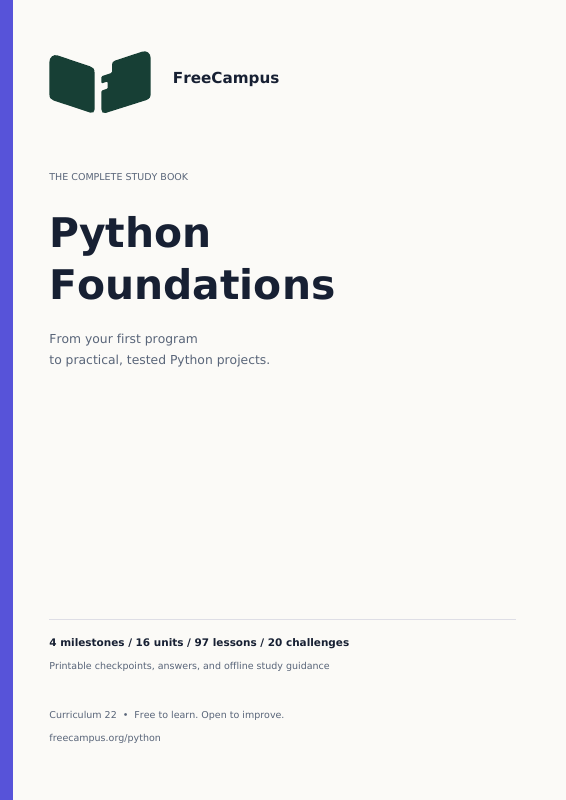
THE COMPLETE STUDY BOOK
Python Foundations, wherever you study
Read and annotate the full course offline: 16 units, 97 lessons, and 16 unit challenges. Includes printable checkpoints, an answer key, a study guide, and a personal study record.
Download the study bookCode runs in your Python workspace, not inside the PDF. Lesson links lead back to the website and Colab; interactive quizzes and browser progress remain online.
Choose a learning path
Python Foundations is the common entry point. Scientific Computing and Statistics are parallel prerequisites for Data Science and Machine Learning and may be completed in either order.
New to programming?
Begin with Meet Python Through a Tiny Program and run your first examples in a browser.
Already know some Python?
Use the readiness guide to choose a course without repeating skills you can already explain and debug.
Teaching these courses?
Use learner profiles, instructor notes, unit challenges, and visible project rubrics for self-paced or classroom learning.
How every course works
- Understand why the idea matters.
- Predict what a small example will do.
- Run it in Colab, Jupyter, VS Code, or the terminal.
- Explain the result in everyday language.
- Modify one small thing and predict again.
- Debug using evidence instead of guessing.
NoteProgress and certificates
Progress is self-reported in this browser on this device and organized by course. Python Foundations includes 97 lessons, 16 unit challenges, and four milestone challenges. Community courses are ungraded; use the checks and self-review guidance to decide when to record an activity as complete. Verifiable certificates remain planned because they also require identity, assessment evidence, and durable learner records. Browser completion is not presented as a verified credential.