((-2.0, 15.0),
(-1.0, 6.0),
(0.0, 1.0),
(1.0, 0.0),
(2.0, 3.0),
(3.0, 10.0),
(4.0, 21.0))Expressions and Equations
Build symbolic fluency with expressions, identities, equations, and solution sets.
Learning objectives
After this lesson you should be able to:
- distinguish expressions, equations, identities, contradictions, and solution sets;
- evaluate expressions by substitution while tracking the order of operations;
- recognize when two expressions are equivalent;
- expand, factor, collect, and simplify basic algebraic expressions;
- solve one-variable linear equations and check solutions;
- use SymPy to verify algebraic work without replacing mathematical reasoning.
Motivation
Graduate-level quantitative courses assume that algebra is automatic. In calculus, you rearrange expressions before differentiating. In statistics, you solve for parameters and simplify likelihoods. In optimization, you transform constraints. In linear algebra, you solve systems whose entries may be symbolic.
The goal is not to memorize isolated tricks. The goal is to develop a reliable habit:
Convert a problem into symbols, transform the symbols without changing their meaning, and interpret the result in context.
Expressions, equations, and identities
An expression is a mathematical phrase. It can be evaluated, simplified, or transformed, but by itself it is not true or false.
Examples:
3x + 2
x^2 - 5x + 6
2(a + b)
sqrt(x - 1)
An equation states that two expressions are equal:
3x + 2 = 14An equation may be true for one value, many values, all values, or no values.
An identity is true for every value in its domain:
2(x + 3) = 2x + 6A contradiction is never true:
x + 1 = x + 2
TipWhy this distinction matters
When you simplify an expression, you are changing its form. When you solve an equation, you are finding values that make a statement true. Confusing these two tasks is one of the most common causes of algebra mistakes.
Variables, constants, and parameters
A variable represents a quantity that can change. A constant is fixed. A parameter is fixed during one problem but may vary across problems.
For example, in
f(x) = ax + bx is usually the input variable, while a and b are parameters. Changing x moves along one line. Changing a or b changes the line itself.
Evaluating an expression
To evaluate an expression, substitute a value for the variable and follow the order of operations.
Example:
2x^2 - 3x + 1, when x = 4Substitute:
2(4)^2 - 3(4) + 1Compute powers before multiplication:
2(16) - 12 + 1 = 32 - 12 + 1 = 21Use a table when you want to see many inputs at once.
Equivalent expressions
Two expressions are equivalent if they produce the same value for every allowed input.
For example:
(x + 1)^2and
x^2 + 2x + 1are equivalent. One form is factored around a repeated linear factor; the other form is expanded.
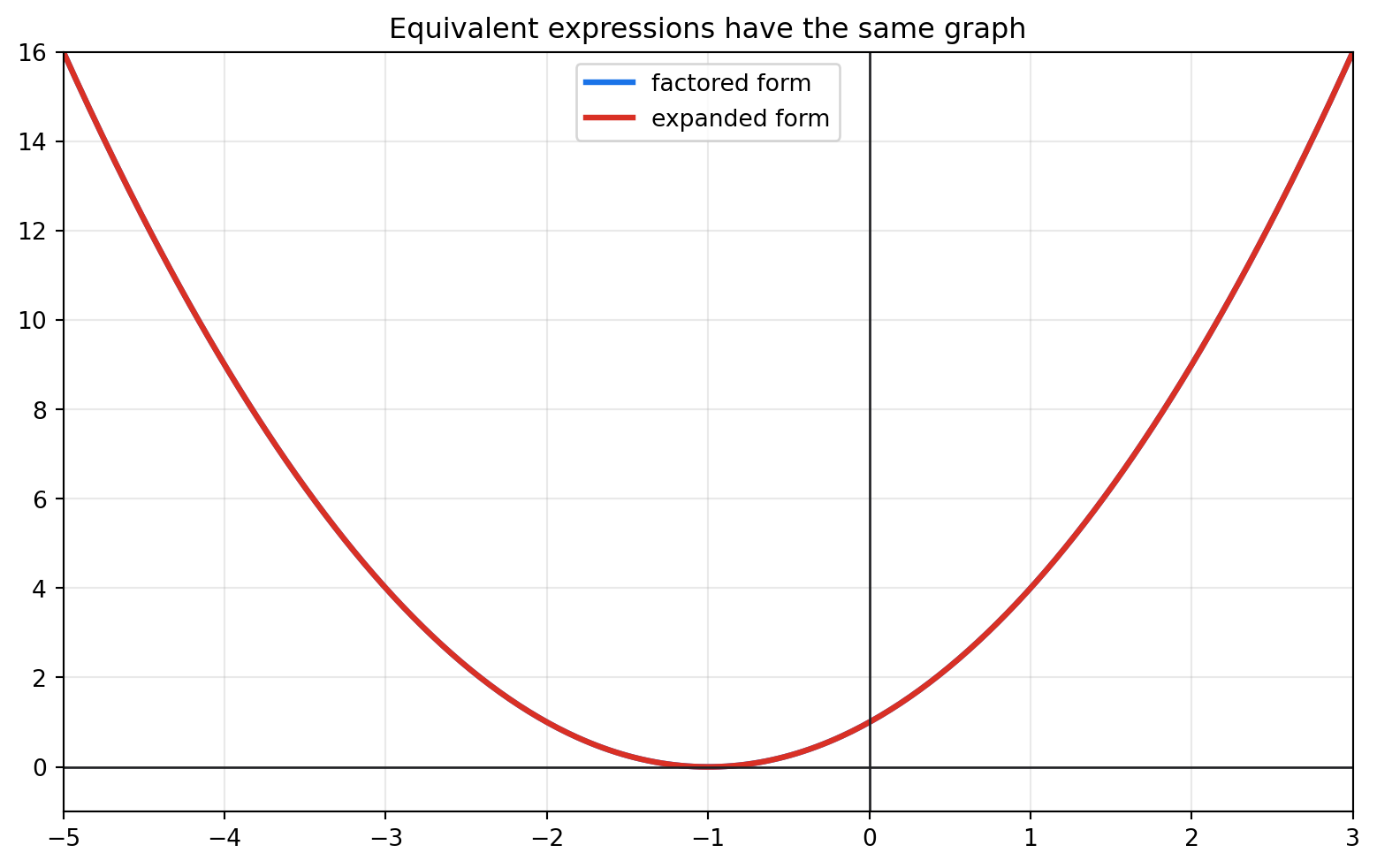
The graph is the same because the two formulas define the same function. The forms emphasize different information:
(x + 1)^2makes the rootx = -1visible.x^2 + 2x + 1makes the coefficients visible.
Expanding, factoring, and simplifying
Algebra often asks you to choose the most useful form.
Expanding
Expanding uses distribution:
(x + 3)(x - 2)Multiply every term in the first factor by every term in the second:
x*x + x*(-2) + 3*x + 3*(-2)
= x^2 - 2x + 3x - 6
= x^2 + x - 6
Factoring
Factoring reverses expansion:
x^2 + x - 6 = (x + 3)(x - 2)This form immediately tells us the zeros: x = -3 and x = 2.
Simplifying
Simplifying means rewriting an expression in a cleaner equivalent form. It does not always mean "shorter"; it means "more useful for the task."
(x**2 + x - 6, (x - 2)*(x + 3))Equations and solution sets
Solving an equation means finding all values that make it true.
Consider:
3x + 2 = 14Subtract 2 from both sides:
3x = 12Divide both sides by 3:
x = 4Check:
3(4) + 2 = 14So the solution set is {4}.
Balanced operations
Whatever operation you perform on one side of an equation must be performed on the other side. The goal is to produce an equivalent equation with the same solution set.
Identities, contradictions, and conditional equations
Not every equation has exactly one answer.
Identity
2(x + 3) = 2x + 6Expanding the left side gives:
2x + 6 = 2x + 6This is true for every x.
Contradiction
x + 1 = x + 2Subtract x from both sides:
1 = 2This is never true, so there is no solution.
Conditional equation
4x - 7 = 9This is true only when x = 4.
Domain restrictions
Algebraic transformations must respect domain restrictions.
For example:
(x^2 - 1)/(x - 1)can be simplified as:
((x - 1)(x + 1))/(x - 1) = x + 1but the original expression is undefined at x = 1. The simplified expression x + 1 is defined at x = 1, so the two expressions are equivalent only when x != 1.
WarningImportant
Cancelling a factor can remove visible evidence of a restriction. Always record values that make a denominator zero, a logarithm invalid, or an even root undefined over the real numbers.
SymPy as a verification tool
The package’s quiz helpers can generate questions where the expected answer is derived from the expression.
('Correct.', 'Correct.')Use this as a checker, not as a replacement for understanding. A computer algebra system can confirm equivalence, but you still need to know which form is useful and what restrictions apply.
Worked examples
Example 1: expand and interpret
Expand:
(x - 4)(x + 2)Solution:
x^2 + 2x - 4x - 8 = x^2 - 2x - 8Interpretation:
- Factored form shows zeros at
x = 4andx = -2. - Expanded form shows degree
2, leading coefficient1, and constant term-8.
Example 2: solve a linear equation
Solve:
5 - 2x = 17Subtract 5:
-2x = 12Divide by -2:
x = -6Check:
5 - 2(-6) = 5 + 12 = 17Example 3: classify an equation
Classify:
3(x - 2) + 6 = 3xExpand:
3x - 6 + 6 = 3xSimplify:
3x = 3xThis is an identity.
Common mistakes
Changing only one side
If you subtract 2 from the left side but not the right side, the new equation is not equivalent to the original.
Losing a negative sign
When solving -3x = 12, divide by -3, not by 3. The solution is x = -4.
Cancelling terms instead of factors
In (x + 3)/x, you cannot cancel the x in the denominator with the x inside x + 3. Cancellation applies to common factors, not pieces of sums.
Ignoring restrictions
If an original denominator is zero at a value, that value is excluded even if a simplified expression appears to allow it.
Practice
- Evaluate
2x + 5whenx = 3. - Evaluate
x^2 - 4x + 1whenx = -2. - Expand
(x + 5)(x - 1). - Factor
x^2 - 7x + 10. - Solve
4x - 7 = 9. - Solve
-2x + 6 = 14. - Classify
2(x + 4) = 2x + 8as identity, contradiction, or conditional equation. - Classify
x + 5 = x - 1. - State the restriction for
(x^2 - 9)/(x - 3). - Explain why
(x^2 - 9)/(x - 3)is not exactly the same function asx + 3over all real numbers. - Solve
a*x + b = cforx, assuminga != 0. - Challenge: create two different-looking expressions that are equivalent to
x^2 - 4.
Solutions
TipSolution 1
Answer: 11.
Substitute x = 3: 2(3) + 5 = 6 + 5 = 11.
TipSolution 2
Answer: 13.
(-2)^2 - 4(-2) + 1 = 4 + 8 + 1 = 13.
TipSolution 3
Answer: x^2 + 4x - 5.
(x + 5)(x - 1) = x^2 - x + 5x - 5 = x^2 + 4x - 5.
TipSolution 4
Answer: (x - 5)(x - 2).
We need two numbers that multiply to 10 and add to -7: -5 and -2.
TipSolution 5
Answer: x = 4.
Add 7 to both sides to get 4x = 16, then divide by 4.
TipSolution 6
Answer: x = -4.
Subtract 6 from both sides to get -2x = 8, then divide by -2.
TipSolution 7
Answer: identity.
The left side expands to 2x + 8, so both sides are the same expression.
TipSolution 8
Answer: contradiction.
Subtracting x from both sides gives 5 = -1, which is never true.
TipSolution 9
Answer: x != 3.
The denominator x - 3 cannot equal zero.
TipSolution 10
(x^2 - 9)/(x - 3) simplifies to x + 3 for x != 3, but the original expression is undefined at x = 3. The graph has a removable hole there.
TipSolution 11
Answer: x = (c - b)/a.
Subtract b from both sides: a*x = c - b. Divide by a, assuming a != 0.
TipSolution 12
Two examples are (x - 2)(x + 2) and (x^2 - 2x) + (2x - 4).
There are infinitely many equivalent forms. The important skill is being able to prove equivalence by algebraic transformation.
Why this matters later
- Calculus: simplifying before differentiating or integrating can turn a hard problem into an easy one.
- Linear algebra: equations become systems, and systems become matrix equations.
- Statistics: parameters are estimated by solving or optimizing algebraic expressions.
- Optimization: constraints are equations and inequalities that define the feasible set.
Subtopic guided practice and checkpoints
Use these mini-labs after the main explanations. Each lab asks you to guess first, then follow the steps, then try a checkpoint without looking back.
Lab 1: expression, equation, or identity?
Guess first. Decide whether each object is an expression, an equation, or an identity.
A. 3x - 7
B. 3x - 7 = 11
C. 2(x + 1) = 2x + 2
Guided exercise.
- Look for an equals sign. No equals sign means expression, so A is an expression.
- If there is an equals sign, ask whether it is true for all allowed values or only some values.
- B is an equation because it is true only for
x = 6. - C is an identity because expanding the left side gives
2x + 2, so both sides match for everyx.
Checkpoint. Classify each: 5 - y, y^2 = 9, (x - 4)^2 = x^2 - 8x + 16. Then write one sentence explaining how you decided.
Lab 2: substitute carefully
Guess first. For E = 2a^2 - 3b, estimate whether the value is positive or negative when a = -2 and b = 5.
Guided exercise.
E = 2a^2 - 3b
  = 2(-2)^2 - 3(5)
  = 2(4) - 15
  = 8 - 15
  = -7
Notice that (-2)^2 = 4. Parentheses protect the negative sign.
Checkpoint. Evaluate 4p - 2q^2 when p = -3 and q = -2. Show the substitution line before simplifying.
Lab 3: build equivalent forms
Guess first. Is (x + 5)(x - 2) equivalent to x^2 + 3x - 10, x^2 - 3x - 10, or x^2 + 7x - 10?
Guided exercise.
(x + 5)(x - 2)
= x(x - 2) + 5(x - 2)
= x^2 - 2x + 5x - 10
= x^2 + 3x - 10
Every equivalent form tells a different story: expanded form shows coefficients, while factored form shows roots.
Checkpoint. Expand (2x - 1)(x + 4). Then factor your result back to check.
Lab 4: solve and check a linear equation
Guess first. In 4(x - 2) + 3 = 19, should x be smaller than 5, equal to 5, or larger than 5?
Guided exercise.
4(x - 2) + 3 = 19
4x - 8 + 3 = 19        expand
4x - 5 = 19            combine like terms
4x = 24                add 5 to both sides
x = 6                  divide by 4
Check in the original equation:
4(6 - 2) + 3 = 16 + 3 = 19Checkpoint. Solve 3(2x + 1) - 5 = 16. Show each balanced operation and check the answer in the original equation.
Guessing game checkpoint
Before moving to the Python/SymPy appendix, practice the core moves from this lesson. This short quiz may show an expression, graph, equation, solution set, or description and ask you to choose the matching mathematical object.
Using this lesson with edumath and SymPy
Use the parser/solver workflow when a text equation should become a SymPy equation first and a step-by-step edumath solution second.
from edumath.core import parse_equation
from edumath.solvers import solve_equation_steps

step_solution = solve_equation_steps(parse_equation("4(x - 2) + 3 = 19"))
print(step_solution.render_text())
Answer: x = 6
Method: linear equation
Steps:
1. Original equation:
Eq(4*(x - 1*2) + 3, 19)
2. Expand both sides:
Eq(4*x - 5, 19)
3. Move everything to one side:
Eq(4*x - 24, 0)
This writes the equation in the form ax + b = 0.
4. Move the constant term:
Eq(4*x, 24)
5. Divide by the coefficient of the variable:
Eq(x, 6)
Check:
x = 6: validUse SymPy to check symbolic transformations and use edumath quiz helpers to turn those transformations into auto-checkable practice.
import sympy as sp

from edumath.algebra import expand_question, factor_question

x = sp.Symbol("x")
expanded = sp.expand((x + 3) * (x - 2))
factored = sp.factor(x**2 + x - 6)
expanded, factored
(x**2 + x - 6, (x - 2)*(x + 3))question = expand_question((x + 1) ** 2)
question.check("x**2 + 2*x + 1").message'Correct.'Further reading
- OpenStax, College Algebra 2e, Chapter 1 and Chapter 2: https://openstax.org/books/college-algebra-2e/pages/index
- Paul’s Online Math Notes, Algebra: https://tutorial.math.lamar.edu/