Systems of Equations
Solve simultaneous constraints by graphing, substitution, elimination, and checking.
Learning objectives
After this lesson you should be able to:
- decide whether an ordered pair solves a system;
- solve two-variable linear systems by graphing, substitution, and elimination;
- classify systems as one solution, no solution, or infinitely many solutions;
- translate simple word problems into systems;
- recognize basic nonlinear systems as graph intersections;
- use SymPy to solve and check systems.
Motivation: several conditions at once
A system of equations describes several conditions that must all be true at the same time. A solution to a system must satisfy every equation, not just one.
What counts as a solution?
Consider:
x + y = 5
x - y = 1
(3, 2) works because 3 + 2 = 5 and 3 - 2 = 1. (5, 0) fails because it satisfies the first equation but not the second.
Graphical interpretation
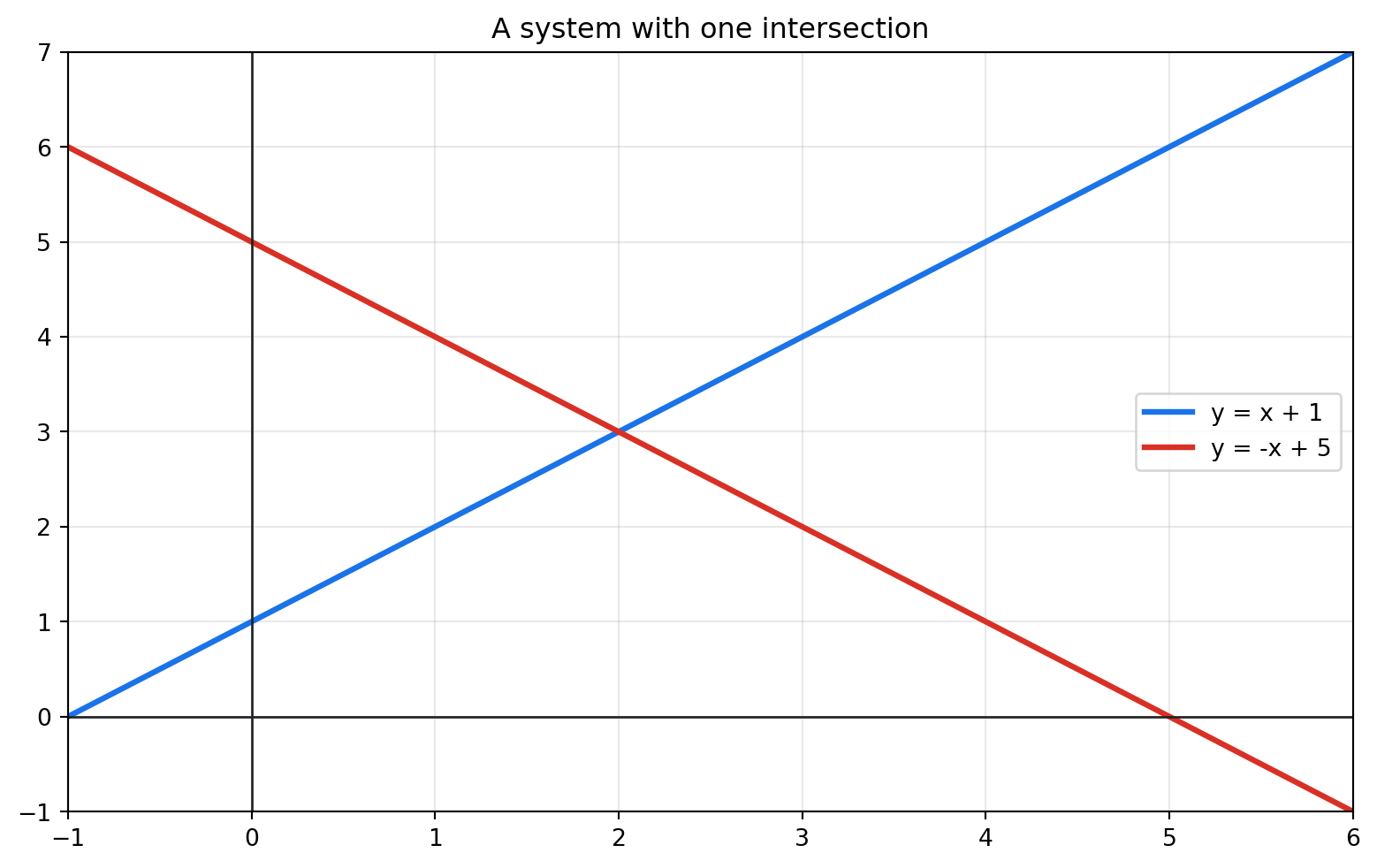
In two variables, each linear equation is a line. A system asks where the lines share points.
- Intersecting lines: one solution.
- Parallel distinct lines: no solution.
- Same line written two ways: infinitely many solutions.
Solving by substitution
Substitution is useful when one equation is already solved for a variable.
Solve:
y = 2x + 1
x + y = 10
Substitute 2x + 1 for y:
x + (2x + 1) = 10
3x + 1 = 10
x = 3
Then y = 2(3) + 1 = 7. Solution: (3, 7).
Solving by elimination
Elimination is useful when adding or subtracting equations removes a variable.
2x + 3y = 12
4x - 3y = 6
Add equations:
6x = 18
x = 3
Substitute back:
2(3) + 3y = 12
y = 2
Solution: (3, 2).
Classifying systems
For:
a1*x + b1*y = c1
a2*x + b2*y = c2
look at a1*b2 - a2*b1.
- Nonzero: one solution.
- Zero: parallel or identical lines; compare constants.
Examples:
2x + 3y = 12
4x + 6y = 20
No solution, because the left side doubled but the constant did not. In contrast,
2x + 3y = 12
4x + 6y = 24
has infinitely many solutions.
Word problems with systems
Use this routine:
- Define variables with units.
- Translate each condition into an equation.
- Solve.
- Interpret and check.
A club sold 50 tickets. Adult tickets cost $10, student tickets cost $6, and total revenue was $380.
a + s = 50
10a + 6s = 380
From s = 50 - a:
10a + 6(50 - a) = 380
4a = 80
a = 20
s = 30
Three-variable and nonlinear previews
Three-variable systems use the same idea: find values satisfying every equation. Later, linear algebra turns these into matrix equations.
Nonlinear systems are intersections too. For:
y = x^2
y = x + 2
substitution gives x^2 = x + 2, so x = 2 or x = -1. The points are (2, 4) and (-1, 1).
Common mistakes
Common mistakes
Give an ordered pair, not only one coordinate. Check every equation. Be careful with signs during elimination.
Browser symbolic practice
Try checking systems with math.js, Nerdamer, Algebrite, or PyScript. Good activities: test candidate points, solve a 2-by-2 system, graph moving lines, or preview matrix solving.
Practice exercises
- Does
(2, 3)solvex + y = 5and2x - y = 1? - Solve by substitution:
y = x + 4,2x + y = 10. - Solve by elimination:
x + y = 7,x - y = 1. - Classify:
2x + 3y = 6,4x + 6y = 12. - Classify:
2x + 3y = 6,4x + 6y = 15. - Set up and solve:
30tickets, adult$12, child$7, revenue$310. - Solve
y = x^2,y = 4. - Explain why parallel distinct lines have no solution.
TipSolutions
- Yes.
(2, 6).(4, 3).- Infinitely many solutions.
- No solution.
a + c = 30,12a + 7c = 310; solutiona = 20,c = 10.(2, 4)and(-2, 4).- They never intersect, so no ordered pair lies on both.
Subtopic guided practice and checkpoints
A system solution must satisfy every equation at the same time. Guess the graph picture before choosing a method.
Lab 1: test an ordered pair
Guess first. Does (2, 3) look likely to solve x + y = 5 and 2x - y = 1?
Guided exercise.
x + y = 5       -> 2 + 3 = 5       true
2x - y = 1      -> 2(2) - 3 = 1    true
Because both equations are true, (2, 3) is a solution.
Checkpoint. Test whether (4, -1) solves x + y = 3 and x - 2y = 6.
Lab 2: substitution
Guess first. In y = x + 4 and 2x + y = 10, which expression should you substitute?
Guided exercise.
y = x + 4
2x + y = 10
2x + (x + 4) = 10       substitute x + 4 for y
3x + 4 = 10
3x = 6
x = 2
y = 2 + 4 = 6
Solution: (2, 6).
Checkpoint. Solve y = 3x - 1 and x + y = 11 by substitution.
Lab 3: elimination
Guess first. In 3x + 2y = 16 and x - 2y = 4, what happens if you add the equations?
Guided exercise.
 3x + 2y = 16
+x - 2y = 4
-------------
 4x      = 20
 x = 5
Substitute back:
5 - 2y = 4
-2y = -1
y = 1/2
Checkpoint. Solve 2x + y = 11 and 3x - y = 9 by elimination.
Lab 4: classify the system
Guess first. Do the equations 2x + 4y = 8 and x + 2y = 4 represent parallel lines or the same line?
Guided exercise.
Multiplying the second equation by 2 gives the first equation exactly:
2(x + 2y = 4) -> 2x + 4y = 8So the system has infinitely many solutions.
Checkpoint. Classify 2x + 4y = 8 and x + 2y = 5. Explain using the idea of multiples.
Guessing game checkpoint
Using this lesson with edumath and SymPy
import sympy as sp

x, y = sp.symbols("x y")
sp.solve((sp.Eq(y, 2*x), sp.Eq(y, x + 3)), (x, y))
{x: 3, y: 6}sp.linsolve((sp.Matrix([[1, 1], [1, -1]]), sp.Matrix([5, 1])), (x, y))\(\displaystyle \left\{\left( 3, \ 2\right)\right\}\)
sp.solve((sp.Eq(y, x**2), sp.Eq(y, x + 2)), (x, y))[(-1, 1), (2, 4)]Further reading
- OpenStax, College Algebra 2e: https://openstax.org/books/college-algebra-2e/pages/index
- OpenStax, Precalculus: https://openstax.org/books/precalculus/pages/index