Sine, cosine, tangent, quadrants, signs, and reference angles on the unit circle.
The unit circle is a circle of radius 1 centered at the origin. It turns trigonometry into coordinate geometry. When an angle starts on the positive x-axis and rotates around the circle, the point where it lands has coordinates:
(cos(theta), sin(theta))
Learning objectives
After this lesson you should be able to:
read cosine as the horizontal coordinate;
read sine as the vertical coordinate;
find tangent as sin(theta)/cos(theta);
use quadrants to determine signs;
use reference angles to find related trig values;
use a unit-circle plot to check values.
Coordinates on the circle
For any angle theta, the unit-circle point is:
x = cos(theta)
y = sin(theta)
Because the radius is 1, every point satisfies:
x^2 + y^2 = 1
Replacing x with cosine and y with sine gives the identity:
cos^2(theta) + sin^2(theta) = 1
Axis angles
Some angles land exactly on an axis.
angle
point
cosine
sine
0 degrees
(1,0)
1
0
90 degrees
(0,1)
0
1
180 degrees
(-1,0)
-1
0
270 degrees
(0,-1)
0
-1
360 degrees
(1,0)
1
0
Quadrants and signs
The quadrant tells the signs of sine and cosine.
Quadrant
x-coordinate
y-coordinate
cosine
sine
tangent
I
positive
positive
+
+
+
II
negative
positive
-
+
-
III
negative
negative
-
-
+
IV
positive
negative
+
-
-
A useful memory phrase is All Students Take Calculus:
Quadrant I: all positive;
Quadrant II: sine positive;
Quadrant III: tangent positive;
Quadrant IV: cosine positive.
Special angles
The most common reference angles are 30, 45, and 60 degrees.
angle
sine
cosine
tangent
30°
1/2
sqrt(3)/2
sqrt(3)/3
45°
sqrt(2)/2
sqrt(2)/2
1
60°
sqrt(3)/2
1/2
sqrt(3)
Use the reference angle for size and the quadrant for sign.
Tangent on the unit circle
Tangent is the ratio:
tan(theta) = sin(theta) / cos(theta)
Tangent is undefined when cos(theta)=0, because division by zero is not allowed. That happens at 90 degrees and 270 degrees.
Worked example 1: locate an angle
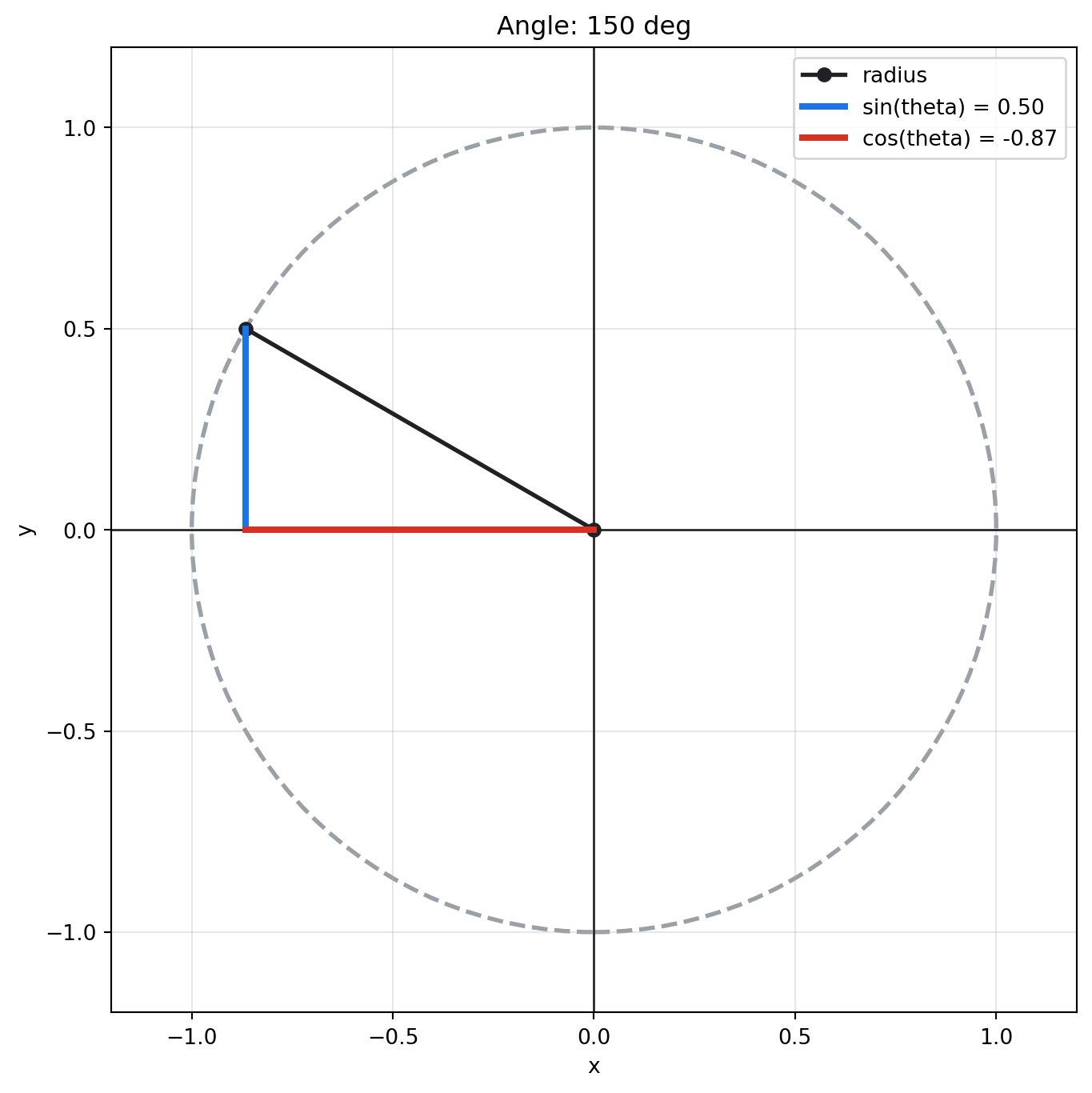
Find the signs of sine, cosine, and tangent at 150 degrees.
150 degrees is in Quadrant II.
In Quadrant II, x is negative and y is positive.
Therefore cosine is negative and sine is positive.
Tangent is sine divided by cosine, so tangent is negative.
Worked example 2: exact value
Find sin(150 degrees).
The reference angle is 180 - 150 = 30 degrees.
sin(30 degrees)=1/2.
150 degrees is in Quadrant II, where sine is positive.
So sin(150 degrees)=1/2.
Common pitfalls
Swapping sine and cosine coordinates.
Forgetting signs in quadrants II, III, and IV.
Saying tangent is defined when cosine is zero.
Memorizing values without understanding reference angles.
Forgetting coterminal angles such as 390 degrees and 30 degrees.
Practice exercises
What is the unit-circle point at 90 degrees?
In Quadrant III, what are the signs of sine and cosine?
Find the reference angle for 300 degrees.
Find cos(120 degrees).
Where is tangent undefined in [0,360)?
TipSolutions
(0,1).
Both sine and cosine are negative.
360-300=60 degrees.
Reference angle 60; Quadrant II cosine is negative, so cos(120)=-1/2.
90 degrees and 270 degrees.
Subtopic guided practice and checkpoints
Use this order: locate the angle, find the reference angle, choose signs, then use the special-angle value.
Lab 1: read coordinates
Guess first. At 0 degrees, is the point on the right or top of the circle?
Guided exercise.
At 0 degrees, the radius points right to (1,0). Therefore:
cos(0)=1
sin(0)=0
Checkpoint. Find sin(270 degrees) and cos(270 degrees).
Lab 2: use signs from quadrants
Guess first. At 225 degrees, should sine be positive or negative?
Guided exercise.
225 degrees is in Quadrant III. In Quadrant III, y is negative, so sine is negative. x is also negative, so cosine is negative.
Checkpoint. Give the signs of sine, cosine, and tangent at 315 degrees.
Lab 3: use reference angles
Guess first. Does 210 degrees have the same reference angle as 30 degrees?
Guided exercise.
210 degrees is in Quadrant III. Its reference angle is:
210 - 180 = 30 degrees
So the size of sine and cosine matches 30 degrees, but the signs are Quadrant III signs.
Checkpoint. Find sin(210 degrees).
Lab 4: tangent as a ratio
Guess first. If sine and cosine have opposite signs, what sign does tangent have?
Guided exercise.
Tangent is sine divided by cosine. A positive divided by a negative is negative, and a negative divided by a positive is negative.
Checkpoint. Find tan(225 degrees).
TipLab checkpoint answers
sin(270)=-1 and cos(270)=0.
At 315 degrees, sine is negative, cosine is positive, and tangent is negative.
sin(210)=-1/2.
Reference angle 45, Quadrant III tangent is positive, so tan(225)=1.
Unit-circle guessing game
Using this lesson with edumath and SymPy
Use edumath to find quadrants, signs, and special-angle values.
from edumath.trigonometry import quadrant, special_angle_values, trig_signsprint(quadrant(210))print(trig_signs(210))print(special_angle_values(30))
III
{'sine': '-', 'cosine': '-', 'tangent': '+'}
ExactTrigValues(sine='1/2', cosine='sqrt(3)/2', tangent='sqrt(3)/3')
Use the plotting helper for a unit-circle picture.
from edumath.trigonometry import plot_unit_circlefig, ax = plot_unit_circle(150)