Inequalities and Absolute Value
Understand solution sets, intervals, constraints, and absolute value as distance.
Learning objectives
After this lesson you should be able to:
- solve linear inequalities and compound inequalities;
- write solution sets using interval notation;
- explain why multiplying an inequality by a negative number reverses the sign;
- interpret absolute value as distance;
- solve absolute value equations and inequalities;
- identify basic domain restrictions from denominators and radicals.
Motivation
Equations often ask for exact values. Inequalities describe allowable regions. That makes them essential for optimization, probability, statistics, and modeling.
Examples:
- A portfolio weight must satisfy
0 <= w <= 1. - A variance must be nonnegative.
- A logarithm input must be positive.
- A feasible region in optimization is defined by inequalities.
An inequality is not a weaker equation. It is a statement about a set of values.
Inequality symbols
x < 3     x is less than 3
x <= 3    x is less than or equal to 3
x > 3     x is greater than 3
x >= 3    x is greater than or equal to 3
The solution to an inequality is usually an interval, not a single point.
x < 3means all real numbers to the left of 3.
Interval notation
Intervals summarize solution sets.
| Inequality | Interval notation | Meaning |
|---|---|---|
x < 3 |
(-∞, 3) |
all numbers less than 3 |
x <= 3 |
(-∞, 3] |
all numbers less than or equal to 3 |
x > -2 |
(-2, ∞) |
all numbers greater than -2 |
-2 <= x < 3 |
[-2, 3) |
from -2 included to 3 excluded |
Parentheses mean an endpoint is not included. Brackets mean it is included.
Solving linear inequalities
Solve:
3x - 5 < 7Add 5 to both sides:
3x < 12Divide by 3:
x < 4Solution set:
(-∞, 4)Why the sign flips
When you multiply or divide by a negative number, the inequality direction reverses.
Example:
-2x < 8Divide by -2:
x > -4Why? Try one value. If x = -5, then -2x = 10, and 10 < 8 is false. If x = -3, then -2x = 6, and 6 < 8 is true. The correct side is x > -4.
Compound inequalities
A compound inequality combines two constraints:
-2 <= 3x + 1 < 10Subtract 1 from all three parts:
-3 <= 3x < 9Divide by 3:
-1 <= x < 3Interval notation:
[-1, 3)Absolute value as distance
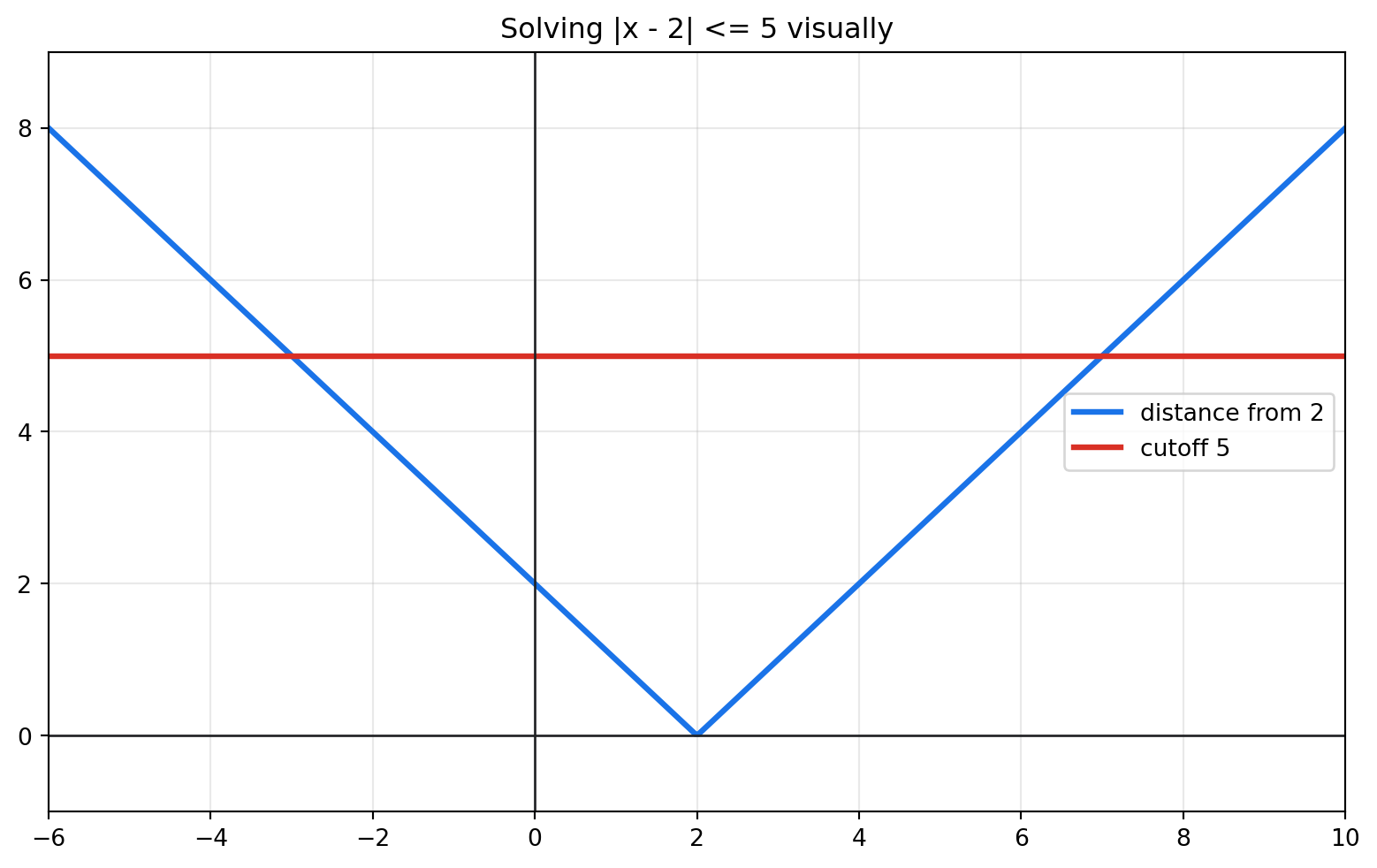
The expression |x - a| is the distance from x to a.
For example:
|x - 2| <= 5means "the distance from x to 2 is at most 5." Therefore:
-5 <= x - 2 <= 5Add 2:
-3 <= x <= 7So the solution is:
[-3, 7]Visualizing absolute value
The graph of |x - a| forms a V-shape centered at x = a. A horizontal cutoff line tells you which points are close enough to the center.
The solution is where the V-shaped graph is at or below the cutoff line.
Domain restrictions as inequalities
Many algebraic expressions only make sense for some inputs.
Denominators
1/(x + 1)requires:
x + 1 != 0so:
x != -1Square roots over the real numbers
sqrt(x - 3)requires:
x - 3 >= 0so:
x >= 3Logarithms
log(x - 4)requires:
x - 4 > 0so:
x > 4Worked examples
Example 1: solve a negative-coefficient inequality
Solve:
5 - 2x >= 17Subtract 5:
-2x >= 12Divide by -2 and reverse the sign:
x <= -6Example 2: solve an absolute value equation
Solve:
|x + 3| = 4The distance from x to -3 is 4, so:
x + 3 = 4 or x + 3 = -4Therefore:
x = 1 or x = -7Example 3: find a domain
Find the real domain of:
sqrt(x - 2)/(x + 1)The square root requires x - 2 >= 0, so x >= 2.
The denominator requires x + 1 != 0, so x != -1.
Because x >= 2 already excludes -1, the domain is:
[2, ∞)Common mistakes
Forgetting to reverse the inequality
Dividing by -2 changes < into > and >= into <=.
Treating absolute value like parentheses
|x - 2| < 5 is not the same as x - 2 < 5. It means the distance from x to 2 is less than 5, which creates a two-sided inequality.
Ignoring endpoint types
x < 3 uses 3) in interval notation, while x <= 3 uses 3].
Practice
- Solve
2x + 1 <= 9. - Solve
-3x + 4 > 16. - Solve
-1 < 2x + 3 <= 7. - Write
(-4, 2]as inequalities. - Solve
|x - 5| < 2. - Solve
|x + 1| >= 3. - Find the real domain of
sqrt(x + 4). - Find the real domain of
1/(x^2 - 9). - Find the real domain of
log(2x - 6). - Challenge: explain why
|x - a| <= rhas solution[a-r, a+r]whenr >= 0.
Solutions
TipSolution 1
2x + 1 <= 9 gives 2x <= 8, so x <= 4.
TipSolution 2
-3x + 4 > 16 gives -3x > 12. Divide by -3 and reverse the sign: x < -4.
TipSolution 3
Subtract 3: -4 < 2x <= 4. Divide by 2: -2 < x <= 2. Interval notation: (-2, 2].
TipSolution 4
-4 < x <= 2.
TipSolution 5
|x - 5| < 2 means -2 < x - 5 < 2. Add 5: 3 < x < 7.
TipSolution 6
|x + 1| >= 3 means the distance from x to -1 is at least 3. So x + 1 <= -3 or x + 1 >= 3. Therefore x <= -4 or x >= 2.
TipSolution 7
sqrt(x + 4) requires x + 4 >= 0, so x >= -4.
TipSolution 8
The denominator cannot be zero. x^2 - 9 = (x - 3)(x + 3), so exclude x = 3 and x = -3.
TipSolution 9
The logarithm input must be positive: 2x - 6 > 0, so x > 3.
TipSolution 10
|x - a| <= r means the distance between x and a is at most r. That means x can be no more than r units left of a and no more than r units right of a, so a - r <= x <= a + r.
Why this matters later
- Optimization: constraints are inequalities that define feasible regions.
- Probability: random variables often have restricted support such as
x >= 0. - Calculus: domains determine where limits, derivatives, and integrals make sense.
- Statistics: confidence intervals and hypothesis-test rejection regions are sets defined by inequalities.
Subtopic guided practice and checkpoints
Inequality work is about preserving the direction of comparison. Guess first, solve carefully, then test a value from your answer set.
Lab 1: interval notation and endpoints
Guess first. Does [-2, 5) include -2? Does it include 5?
Guided exercise.
- A square bracket means the endpoint is included.
- A parenthesis means the endpoint is not included.
- Therefore
[-2, 5)includes-2, all numbers between-2and5, but not5.
Checkpoint. Write x > -3 and x <= 4 in interval notation. Then draw the number-line endpoint types in your notes.
Lab 2: solve a linear inequality
Guess first. For -2x + 5 < 13, will the final inequality point left or right?
Guided exercise.
-2x + 5 < 13
-2x < 8                subtract 5
x > -4                 divide by -2 and reverse the inequality
Test x = 0, which is greater than -4:
-2(0) + 5 < 13
5 < 13                 true
Checkpoint. Solve 7 - 3x >= 16. Explain exactly when and why the sign changes direction.
Lab 3: solve a compound inequality
Guess first. Does -1 <= 2x + 3 < 9 produce one interval or two separate intervals?
Guided exercise.
-1 <= 2x + 3 < 9
-4 <= 2x < 6           subtract 3 from all three parts
-2 <= x < 3            divide all three parts by 2
The answer is one connected interval: [-2, 3).
Checkpoint. Solve 4 < 3x - 2 <= 13 and write the answer in interval notation.
Lab 4: absolute value as distance
Guess first. If |x - 4| = 6, should there be one solution or two?
Guided exercise.
|x - 4| = 6 means “the distance from x to 4 is 6.”
x - 4 = 6      or      x - 4 = -6
x = 10                 x = -2
For inequalities, translate distance language:
|x - 4| < 6 means -6 < x - 4 < 6Checkpoint. Solve |2x + 1| <= 7. Then test one number inside the interval and one number outside it.
Guessing game checkpoint
Before moving to the Python/SymPy appendix, practice the core moves from this lesson. This short quiz may show an expression, graph, equation, solution set, or description and ask you to choose the matching mathematical object.
Using this lesson with edumath and SymPy
SymPy can solve inequalities and show interval-style answers. Use it to verify your work after you solve the inequality by hand.
import sympy as sp

x = sp.Symbol("x", real=True)
sp.solve_univariate_inequality(-2 <= 3*x + 1, x)
\(\displaystyle -1 \leq x\)
sp.solve_univariate_inequality(sp.Abs(x - 2) <= 5, x)\(\displaystyle -3 \leq x \wedge x \leq 7\)
Further reading
- OpenStax, College Algebra 2e, Section 2.7: https://openstax.org/books/college-algebra-2e/pages/index
- Khan Academy, Algebra 2: https://www.khanacademy.org/algebra2