\(\displaystyle 2 x^{2} - 12 x + 19\)
Transformations, Composition, and Inverses
Learn how functions move, combine, compose, and reverse.
Learning objectives
After this lesson you should be able to:
- describe vertical and horizontal shifts, stretches, compressions, and reflections;
- interpret parameters in
a*f(b*(x-h)) + k; - compute sums, differences, products, quotients, and compositions of functions;
- track domain restrictions under operations and composition;
- explain what an inverse function does and when it exists.
Motivation
Once you understand a basic function family, transformations let you build many related functions without starting from scratch.
For example, y = x^2 is a base shape. The function:
y = 2(x - 3)^2 + 1is still a quadratic, but it has been shifted, stretched, and moved. Being able to read this immediately is essential for graphing, modeling, optimization, and calculus.
The transformation template
A useful general template is:
g(x) = a*f(b*(x - h)) + kwhere:
avertically stretches/compresses and may reflect across the x-axis;bhorizontally compresses/stretches and may reflect across the y-axis;hshifts the graph horizontally;kshifts the graph vertically.
WarningHorizontal transformations feel backward
The expression f(x - 3) shifts the graph right by 3, not left. The input must be 3 units larger before the base function sees the same internal value.
Visual example
Compare f(x)=x^2 with g(x)=2(x-3)^2+1.
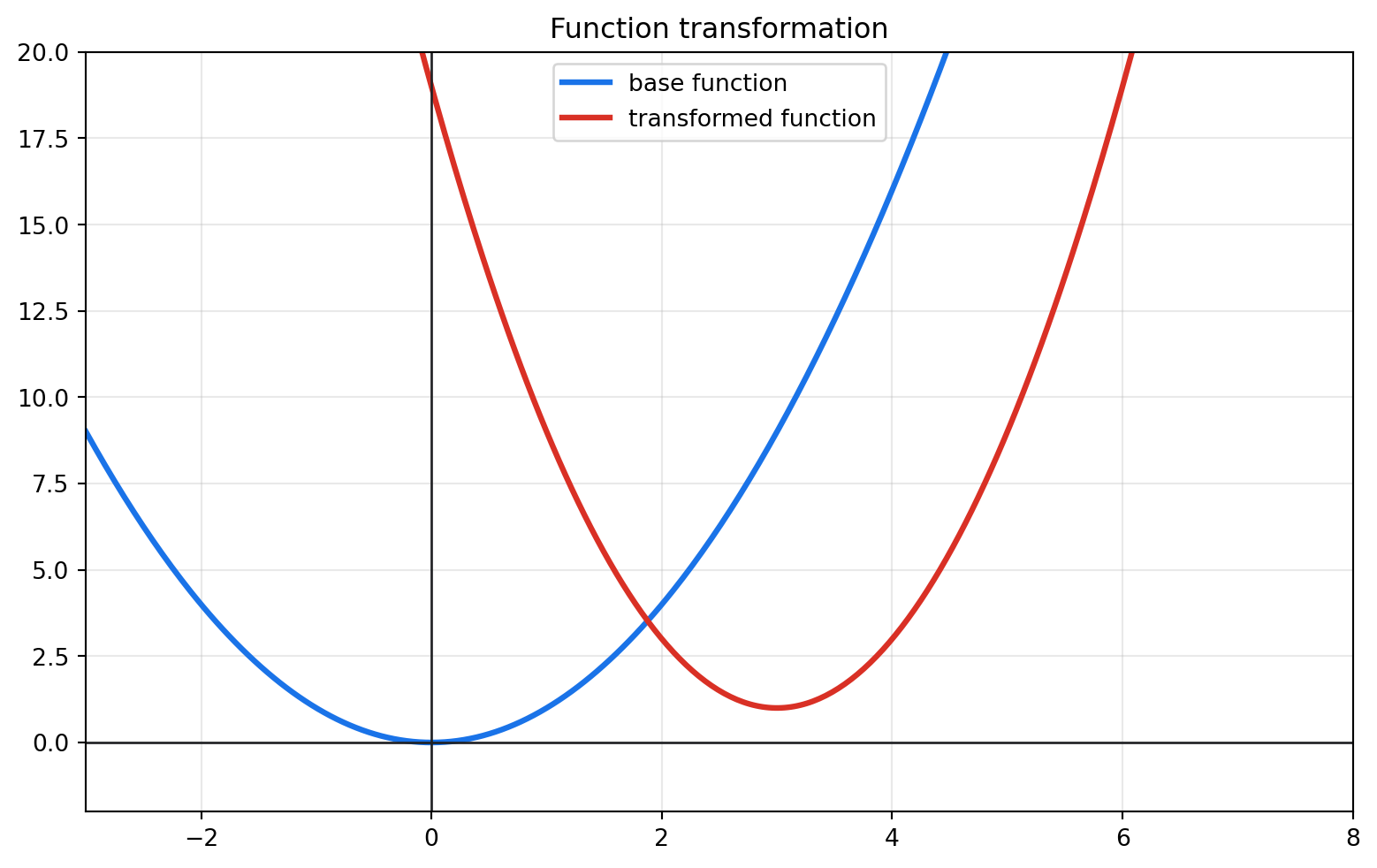
The base vertex (0, 0) becomes (3, 1), and the graph becomes narrower because of the vertical stretch by 2.
Function arithmetic
If two functions have compatible domains, we can combine them:
(f + g)(x) = f(x) + g(x)
(f - g)(x) = f(x) - g(x)
(f*g)(x) = f(x)g(x)
(f/g)(x) = f(x)/g(x), where g(x) != 0
Example:
f(x) = x^2
g(x) = 3x - 1
Then:
(f + g)(x) = x^2 + 3x - 1
(f*g)(x) = x^2(3x - 1) = 3x^3 - x^2
For a quotient, the denominator creates restrictions.
Composition
Composition means feeding the output of one function into another.
(f ∘ g)(x) = f(g(x))If:
f(x) = x^2
g(x) = x + 1
then:
(f ∘ g)(x) = f(g(x)) = f(x + 1) = (x + 1)^2But:
(g ∘ f)(x) = g(f(x)) = g(x^2) = x^2 + 1Composition usually does not commute:
f(g(x)) != g(f(x))Domain under composition
The domain of f(g(x)) must satisfy two requirements:
xmust be allowed ing.g(x)must be allowed as an input tof.
Example:
f(x) = sqrt(x)
g(x) = x - 2
Then:
f(g(x)) = sqrt(x - 2)So we require:
x - 2 >= 0Therefore:
x >= 2Inverse functions
An inverse function reverses the effect of another function.
If:
f(x) = 2x + 3then:
f^{-1}(x) = (x - 3)/2because:
f^{-1}(f(x)) = xand:
f(f^{-1}(x)) = xOne-to-one functions
A function has an inverse function only when it is one-to-one: each output comes from exactly one input.
The horizontal line test checks this on a graph. If any horizontal line hits the graph more than once, the function is not one-to-one.
Example:
f(x)=2x+3is one-to-one.f(x)=x^2over all real numbers is not one-to-one becausef(2)=4andf(-2)=4.
However, f(x)=x^2 restricted to x >= 0 does have an inverse:
f^{-1}(x) = sqrt(x)Worked examples
Example 1: describe a transformation
Describe:
g(x) = -3(x + 2)^2 - 5From f(x)=x^2:
x + 2 = x - (-2), so shift left2;- multiply by
-3, so reflect across the x-axis and vertically stretch by3; - subtract
5, so shift down5.
Example 2: compose functions
Let:
f(x) = 1/(x - 1)
g(x) = x^2
Then:
f(g(x)) = 1/(x^2 - 1)Domain restriction:
x^2 - 1 != 0so:
x != -1 and x != 1Example 3: find an inverse
Find the inverse of:
f(x) = 5x - 4Write:
y = 5x - 4Swap x and y:
x = 5y - 4Solve for y:
x + 4 = 5y
y = (x + 4)/5
So:
f^{-1}(x) = (x + 4)/5Common mistakes
Reversing the horizontal shift
f(x - 4) shifts right by 4; f(x + 4) shifts left by 4.
Assuming composition commutes
Usually f(g(x)) and g(f(x)) are different functions.
Forgetting quotient restrictions
For (f/g)(x), any input where g(x)=0 must be excluded.
Finding an inverse without checking one-to-one behavior
Some functions need a restricted domain before an inverse function exists.
Practice
- Describe the transformation from
y=x^2toy=(x-5)^2+2. - Describe the transformation from
y=sqrt(x)toy=-sqrt(x+1). - If
f(x)=x^2andg(x)=x+3, computef(g(x)). - If
f(x)=x^2andg(x)=x+3, computeg(f(x)). - Find the domain of
1/(x^2 - 4). - Find the inverse of
f(x)=3x+7. - Explain why
f(x)=x^2is not one-to-one over all real numbers. - Restrict the domain of
f(x)=x^2so that it has inversesqrt(x). - Let
f(x)=sqrt(x)andg(x)=x-6. Find the domain off(g(x)). - Challenge: create a function whose inverse is itself.
Solutions
TipSolution 1
Shift right 5 and up 2.
TipSolution 2
x+1 shifts left 1. The negative sign reflects the graph across the x-axis.
TipSolution 3
f(g(x)) = f(x+3) = (x+3)^2.
TipSolution 4
g(f(x)) = g(x^2) = x^2 + 3.
TipSolution 5
The denominator cannot be zero. x^2 - 4 = (x-2)(x+2), so exclude x=2 and x=-2.
TipSolution 6
Let y=3x+7. Swap variables: x=3y+7. Solve: y=(x-7)/3. So f^{-1}(x)=(x-7)/3.
TipSolution 7
f(2)=4 and f(-2)=4, so two different inputs produce the same output.
TipSolution 8
Restrict to x >= 0. Then each output has exactly one input, and the inverse is sqrt(x).
TipSolution 9
f(g(x)) = sqrt(x - 6), so require x - 6 >= 0. The domain is x >= 6.
TipSolution 10
One example is f(x)=x. Another is f(x)=1/x on the domain x != 0, because applying it twice returns the original input.
Why this matters later
- Calculus: the chain rule is about composition.
- Probability/statistics: transformations of variables change distributions.
- Optimization: parameters shift and stretch objective functions.
- Linear algebra: inverse functions generalize to inverse transformations.
Subtopic guided practice and checkpoints
Transformations and composition are easier when you track the order of actions. Always guess the effect before doing algebra.
Lab 1: read a transformed function
Guess first. Compared with f(x) = x^2, does g(x) = 3(x - 2)^2 - 5 move left or right?
Guided exercise.
Use the template a f(x - h) + k.
a = 3        vertical stretch by 3
h = 2        shift right 2
k = -5       shift down 5
The vertex moves from (0, 0) to (2, -5).
Checkpoint. Describe the transformation from f(x) = |x| to g(x) = -2|x + 4| + 1.
Lab 2: function arithmetic
Guess first. If f(x) = x + 1 and g(x) = x^2, is (f + g)(2) equal to f(g(2))?
Guided exercise.
(f + g)(2) = f(2) + g(2) = 3 + 4 = 7
f(g(2)) = f(4) = 5
Function addition and composition are different operations.
Checkpoint. For f(x) = 2x - 1 and g(x) = x + 5, compute (f - g)(3) and f(g(3)).
Lab 3: composition step by step
Guess first. For f(x) = x^2 + 1 and g(x) = 3x, will f(g(x)) equal g(f(x))?
Guided exercise.
f(g(x)) = f(3x) = (3x)^2 + 1 = 9x^2 + 1
g(f(x)) = g(x^2 + 1) = 3(x^2 + 1) = 3x^2 + 3
They are not equal, so composition usually does not commute.
Checkpoint. Let f(x) = x - 4 and g(x) = x^2. Find f(g(x)) and g(f(x)).
Lab 4: find an inverse
Guess first. If f(x) = 2x - 7, should the inverse undo subtracting 7 before or after undoing multiplying by 2?
Guided exercise.
y = 2x - 7
x = 2y - 7              swap x and y
x + 7 = 2y              add 7
y = (x + 7)/2           divide by 2
So f^{-1}(x) = (x + 7)/2.
Checkpoint. Find the inverse of f(x) = 5x + 3. Then check by computing f(f^{-1}(x)).
Guessing game checkpoint
Before moving to the Python/SymPy appendix, practice the core moves from this lesson. This short quiz may show an expression, graph, equation, solution set, or description and ask you to choose the matching mathematical object.
Using this lesson with edumath and SymPy
Use transformed_expression to generate transformed functions and then compare the base and transformed graphs.
from edumath.algebra import transformation_scene, transformed_expression

transformed_expression("x**2", vertical_scale=2, horizontal_shift=3, vertical_shift=1)
\(\displaystyle 2 x^{2} - 12 x + 19\)
scene = transformation_scene("x**2", vertical_scale=2, horizontal_shift=3, vertical_shift=1)
fig, ax = scene.render()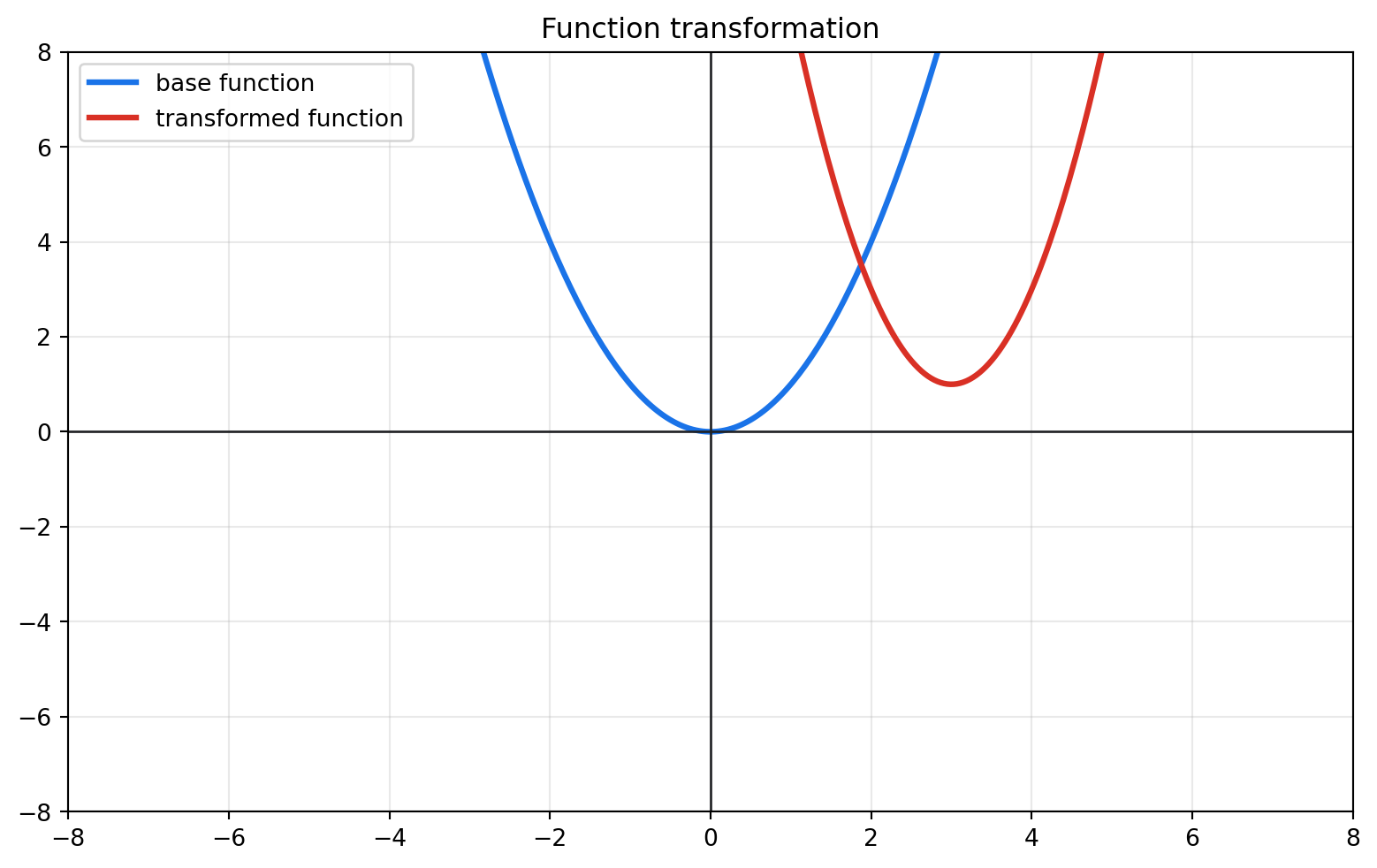
Further reading
- OpenStax, College Algebra 2e, Sections 3.5 and 3.7: https://openstax.org/books/college-algebra-2e/pages/index
- OpenStax, Precalculus, function transformations and inverse functions: https://openstax.org/books/precalculus/pages/index