Sine and Cosine

Sine and cosine as unit-circle coordinates and right-triangle ratios.

Sine and cosine are the core trigonometric functions. On the unit circle, they are coordinates. In a right triangle, they are ratios. As functions, they become repeating waves. This lesson connects the first two meanings so later graph and equation work makes sense.

Learning objectives

After this lesson you should be able to:

  • explain cosine as horizontal coordinate;
  • explain sine as vertical coordinate;
  • compute sine and cosine for common angles;
  • use right-triangle ratios sin = opposite/hypotenuse and cos = adjacent/hypotenuse;
  • decide signs from the quadrant;
  • check values with a unit-circle plot and SymPy.

Sine and cosine on the unit circle

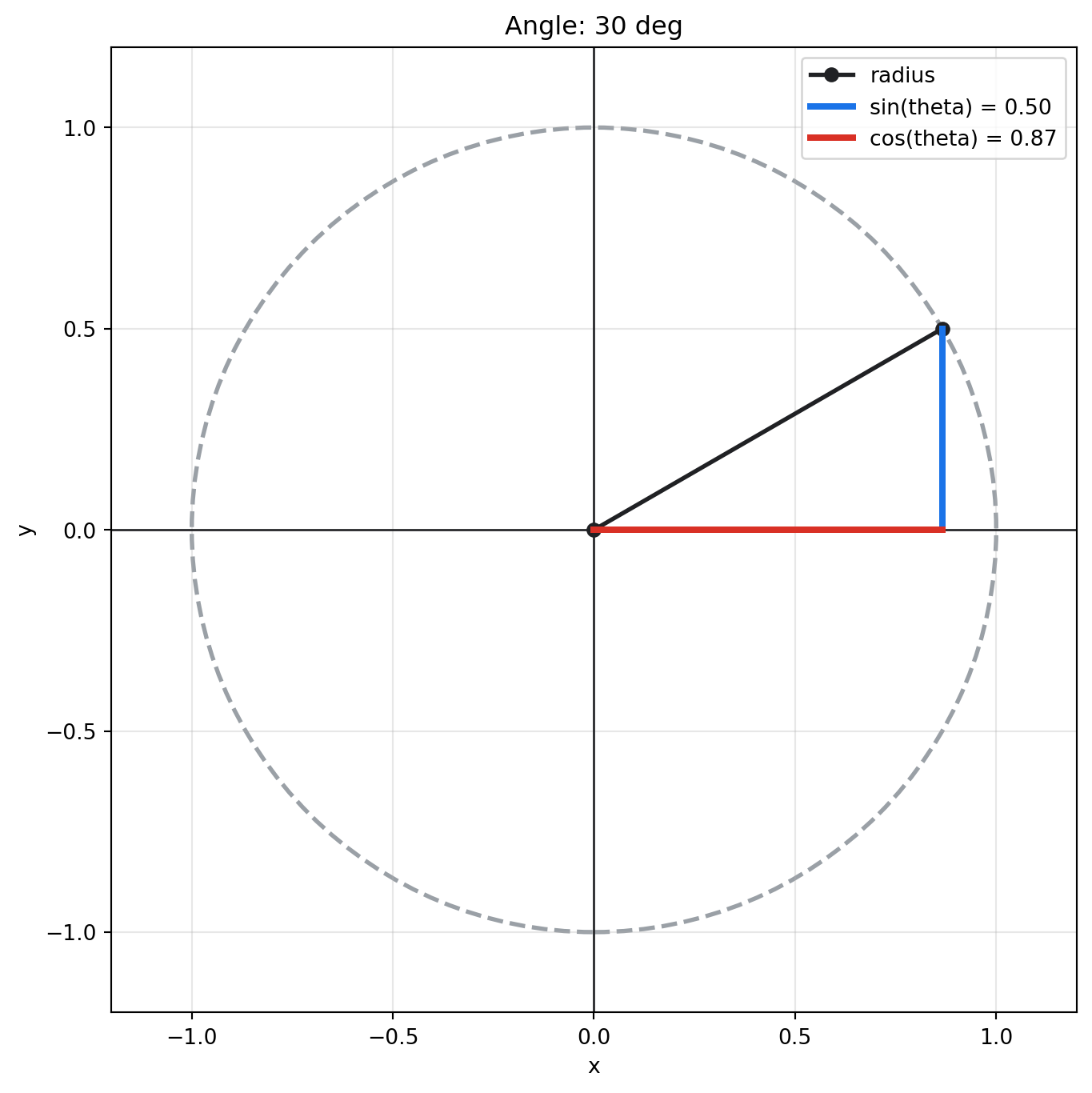
For an angle theta, the unit-circle point is:

(cos(theta), sin(theta))

So:

  • cos(theta) tells how far left or right the point is;
  • sin(theta) tells how far up or down the point is.

At 30 degrees, the point is mostly to the right and slightly above the x-axis, so cosine is larger than sine.

Sine and cosine in right triangles

In a right triangle with acute angle theta:

sin(theta) = opposite / hypotenuse
cos(theta) = adjacent / hypotenuse

The hypotenuse is always the side across from the right angle and is the longest side.

Same values, two viewpoints

For acute angles, the right-triangle ratios match the unit-circle coordinates. The unit circle extends the definitions to angles beyond 0 to 90 degrees.

Special angles

angle sine cosine
0 1
30° 1/2 sqrt(3)/2
45° sqrt(2)/2 sqrt(2)/2
60° sqrt(3)/2 1/2
90° 1 0

Notice that sine increases from 0 to 1 on the first quadrant, while cosine decreases from 1 to 0.

Signs beyond the first quadrant

Use quadrant signs:

Quadrant I:   sine +, cosine +
Quadrant II:  sine +, cosine -
Quadrant III: sine -, cosine -
Quadrant IV:  sine -, cosine +

The reference angle gives the size; the quadrant gives the sign.

Worked example 1: unit-circle value

Find cos(240 degrees).

  1. 240 degrees is in Quadrant III.
  2. The reference angle is 240 - 180 = 60 degrees.
  3. cos(60 degrees)=1/2.
  4. In Quadrant III, cosine is negative.

So:

cos(240 degrees) = -1/2

Worked example 2: right triangle

A right triangle has angle theta, opposite side 5, adjacent side 12, and hypotenuse 13.
sin(theta) = opposite / hypotenuse = 5/13
cos(theta) = adjacent / hypotenuse = 12/13

These ratios do not depend on the triangle’s size, only on the angle.

Common pitfalls

  • Swapping sine and cosine.
  • Using the adjacent side for sine.
  • Forgetting signs outside Quadrant I.
  • Treating sin(theta) as sin * theta; it is function notation.
  • Using decimal approximations when an exact value is expected.

Practice exercises

  1. What are cos(0 degrees) and sin(0 degrees)?
  2. Find sin(60 degrees).
  3. Find cos(120 degrees).
  4. In a right triangle, the opposite side is 7 and hypotenuse is 25. Find sine.
  5. At 300 degrees, is sine positive or negative?
  1. cos(0)=1 and sin(0)=0.
  2. sqrt(3)/2.
  3. Reference angle 60, Quadrant II cosine is negative, so -1/2.
  4. 7/25.
  5. Negative, because 300 degrees is in Quadrant IV.

Subtopic guided practice and checkpoints

Work slowly: identify the angle, choose the viewpoint, then apply the ratio or unit-circle value.

Lab 1: cosine as horizontal coordinate

Guess first. At 180 degrees, is cosine 1, 0, or -1?

Guided exercise.

At 180 degrees, the unit-circle point is (-1,0). Cosine is the x-coordinate, so:

cos(180 degrees) = -1

Checkpoint. Find cos(270 degrees).

Lab 2: sine as vertical coordinate

Guess first. At 90 degrees, is sine 0 or 1?

Guided exercise.

At 90 degrees, the unit-circle point is (0,1). Sine is the y-coordinate, so:

sin(90 degrees) = 1

Checkpoint. Find sin(180 degrees).

Lab 3: right-triangle ratios

Guess first. For sine, do you use opposite or adjacent?

Guided exercise.

SOH-CAH-TOA says:

sin = opposite / hypotenuse
cos = adjacent / hypotenuse

If opposite is 3, adjacent is 4, and hypotenuse is 5, then sin=3/5 and cos=4/5.

Checkpoint. In a 5-12-13 right triangle, with angle opposite side 12, find sine and cosine.

Lab 4: combine reference angle and sign

Guess first. Does sin(210 degrees) have the same sign as sin(30 degrees)?

Guided exercise.

The reference angle is 30 degrees, but 210 degrees is in Quadrant III. Sine is negative in Quadrant III, so:

sin(210 degrees) = -1/2

Checkpoint. Find cos(300 degrees).

  1. cos(270 degrees)=0.
  2. sin(180 degrees)=0.
  3. sin=12/13 and cos=5/13.
  4. Reference angle 60; Quadrant IV cosine is positive, so cos(300)=1/2.

Sine-cosine guessing game

Using this lesson with edumath and SymPy

Use edumath to compute a unit-circle point.

from edumath.trigonometry import plot_unit_circle, special_angle_values, unit_circle_point

point = unit_circle_point(30)
print(point.cosine, point.sine)
print(special_angle_values(30))
0.8660254037844387 0.49999999999999994
ExactTrigValues(sine='1/2', cosine='sqrt(3)/2', tangent='sqrt(3)/3')

Show the unit-circle plot.

fig, ax = plot_unit_circle(30)

Use SymPy for exact sine and cosine.

import sympy as sp

sp.sin(sp.pi / 6), sp.cos(2 * sp.pi / 3)
(1/2, -1/2)