(4, 2)Polynomials
Understand polynomial structure, roots, multiplicity, end behavior, and graph interpretation.
Learning objectives
After this lesson you should be able to:
- identify degree, leading coefficient, terms, and constant term;
- expand, factor, and divide polynomial expressions;
- connect roots, factors, and x-intercepts;
- interpret root multiplicity from a graph;
- predict end behavior from degree and leading coefficient;
- use SymPy helpers to summarize and visualize polynomial structure.
Motivation
Polynomials are algebra’s most flexible elementary functions. They are built from powers of x, but they can approximate complicated functions, model smooth curves, and support numerical methods.
In advanced math, polynomials appear in:
- Taylor approximations in calculus;
- characteristic polynomials in linear algebra;
- regression and interpolation in statistics/numerical methods;
- optimization models and local approximations.
Polynomial vocabulary
A polynomial in one variable has the form:
a_n*x^n + a_{n-1}*x^{n-1} + ... + a_1*x + a_0where:
- exponents are nonnegative integers;
- coefficients are constants;
- the degree is the highest exponent with a nonzero coefficient;
- the leading coefficient is the coefficient of the highest-power term.
Example:
2x^4 - 3x^2 + 7x - 5has degree 4, leading coefficient 2, and constant term -5.
Factored form, roots, and x-intercepts
If a polynomial has a factor (x - r), then r is a root:
p(r) = 0For example:
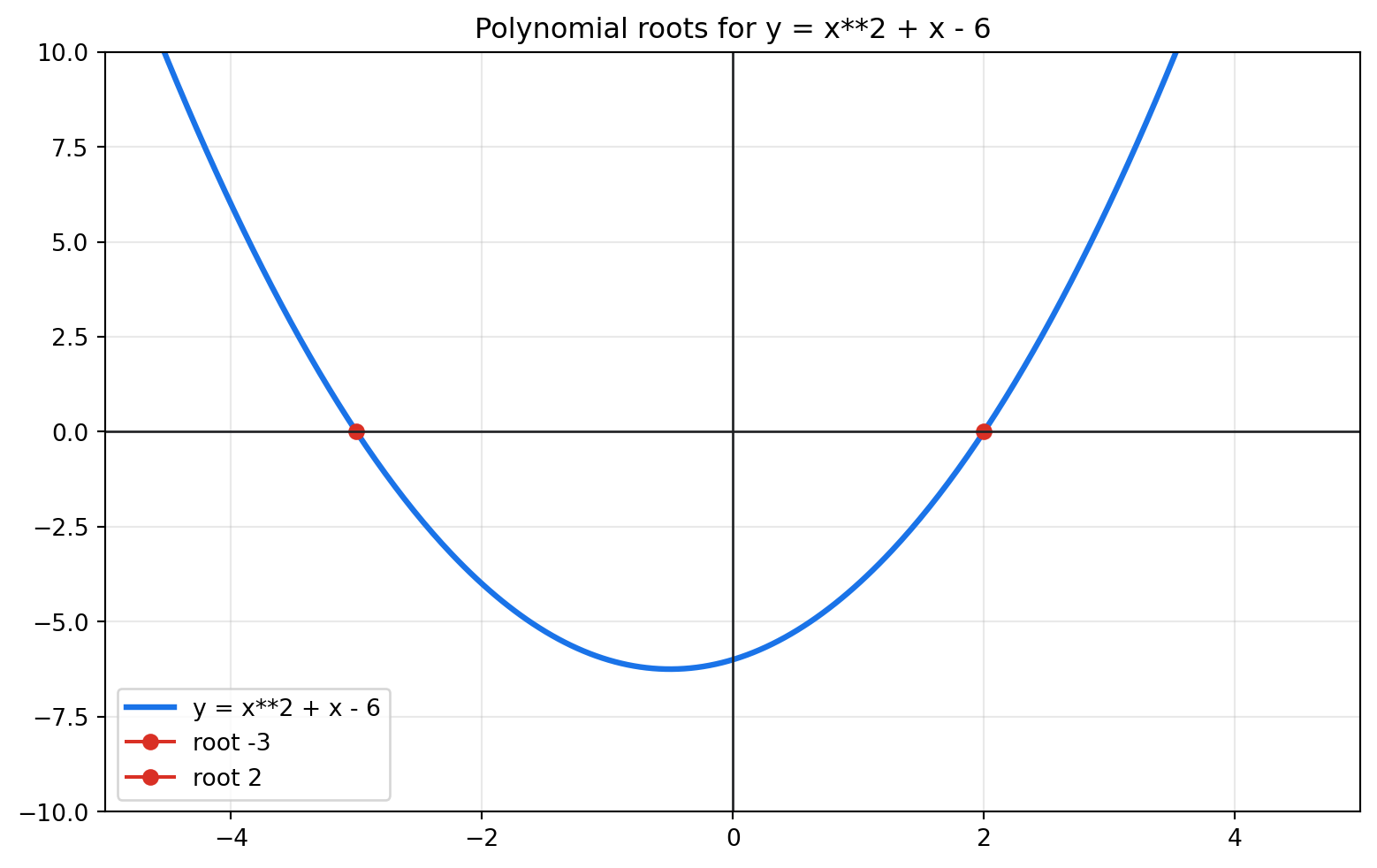
p(x) = (x - 2)(x + 3)has roots:
x = 2 and x = -3Expanded:
(x - 2)(x + 3) = x^2 + x - 6The factored form makes roots visible. The expanded form makes degree, leading coefficient, and constant term visible.
Building polynomials from roots
If the roots are -1, 2, and 4, then one polynomial with those roots is:
(x + 1)(x - 2)(x - 4)\(\displaystyle x^{3} - 5 x^{2} + 2 x + 8\)
Multiplying by a nonzero leading coefficient changes the vertical scale but not the roots.
Multiplicity
A root can occur more than once. The number of times it appears as a factor is called its multiplicity.
Example:
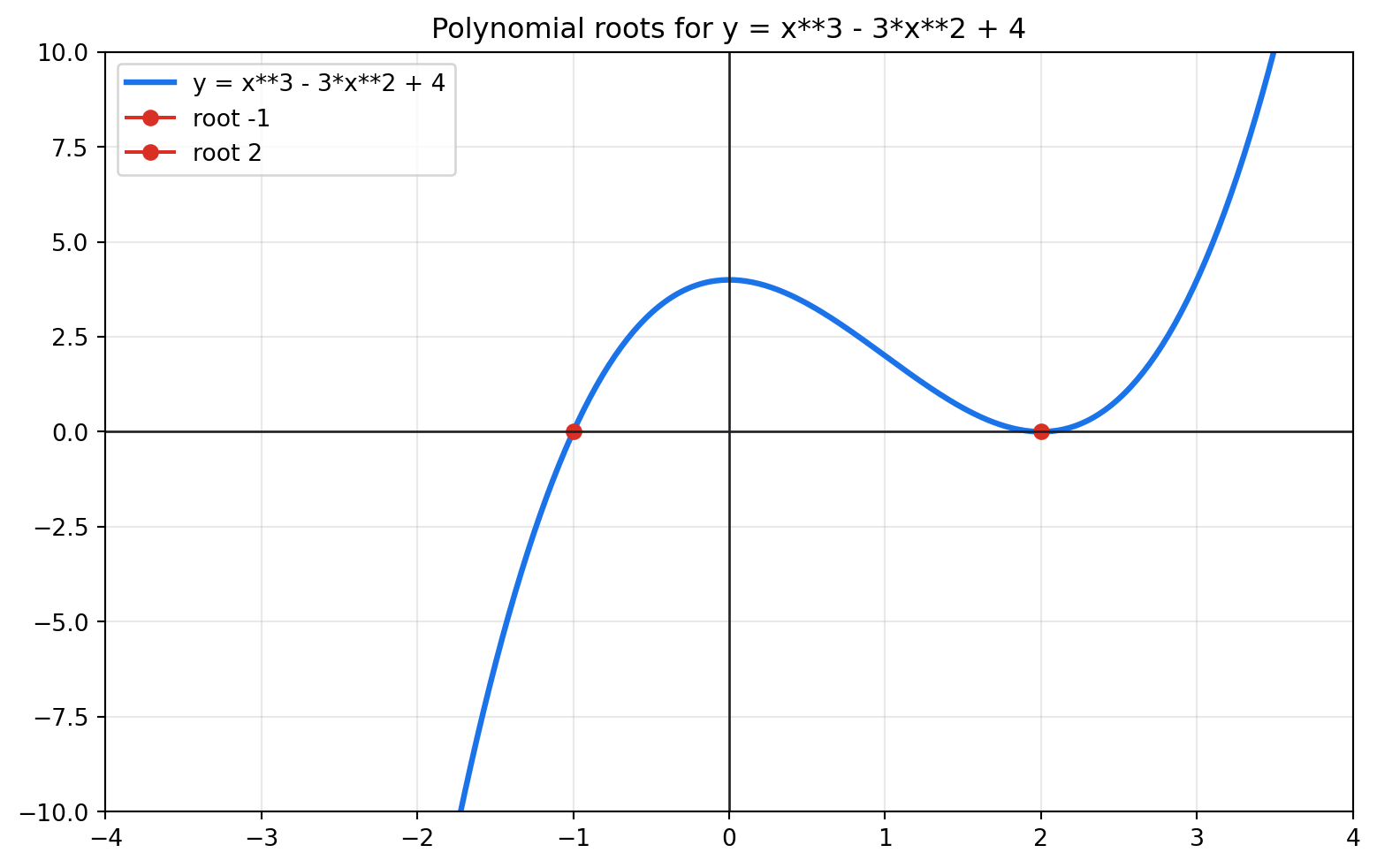
p(x) = (x - 2)^2(x + 1)Root 2 has multiplicity 2. Root -1 has multiplicity 1.
((-1, 1), (2, 2))Graph behavior:
- odd multiplicity: the graph usually crosses the x-axis;
- even multiplicity: the graph touches/bounces off the x-axis.
End behavior
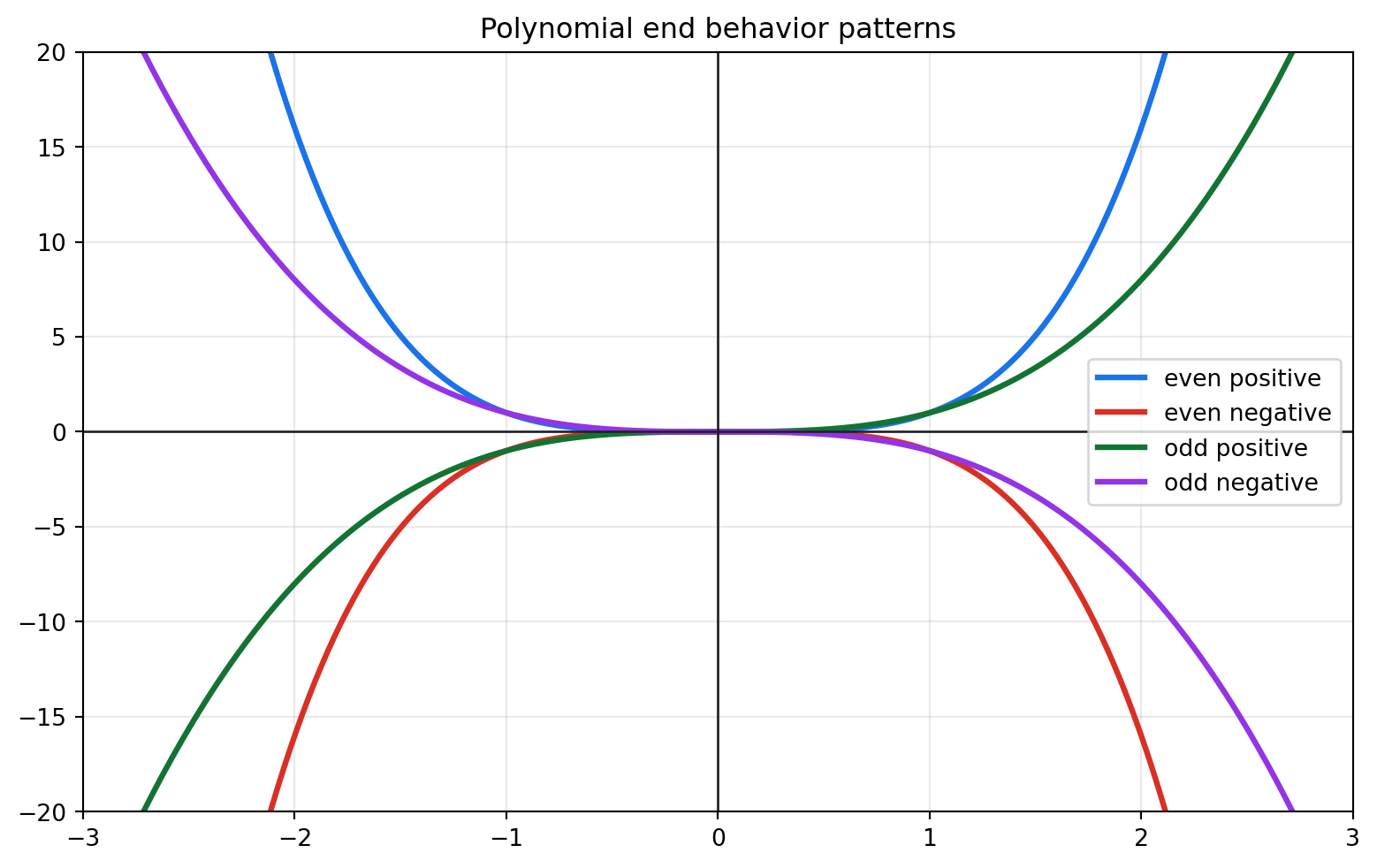
For large positive or negative inputs, the leading term dominates.
For:
p(x) = -2x^5 + 3x^2 - 1the leading term is -2x^5. So for very large |x|, the graph behaves like -2x^5.
Rules:
| Degree | Leading coefficient | Left end | Right end |
|---|---|---|---|
| even | positive | up | up |
| even | negative | down | down |
| odd | positive | down | up |
| odd | negative | up | down |
Polynomial division and the Factor Theorem
The Factor Theorem says:
(x - r) is a factor of p(x) exactly when p(r) = 0Example:
p(x) = x^3 - 3x^2 + 4Check x = 2:
p(2) = 8 - 12 + 4 = 0So (x - 2) is a factor. In fact:
x^3 - 3x^2 + 4 = (x - 2)^2(x + 1)Worked examples
Example 1: summarize a polynomial
p(x) = 4x^5 - x^2 + 8- degree:
5; - leading coefficient:
4; - constant term:
8; - end behavior: odd degree and positive leading coefficient, so left end down and right end up.
Example 2: roots from factored form
p(x) = -3(x - 1)(x + 2)^2Roots:
x = 1, multiplicity1;x = -2, multiplicity2.
The graph crosses at x=1 and bounces at x=-2.
Example 3: construct from roots
Build a monic polynomial with roots -2, 0, and 5:
p(x) = (x + 2)x(x - 5)Expand:
x(x + 2)(x - 5) = x(x^2 - 3x - 10) = x^3 - 3x^2 - 10xCommon mistakes
Confusing roots and coefficients
The roots are input values where the output is zero. They are not usually the same as the coefficients.
Forgetting multiplicity
The root 2 in (x - 2)^2 is not just a root; it is a repeated root. This changes the graph’s behavior.
Predicting end behavior from the constant term
The leading term controls end behavior, not the constant term.
Assuming every root is real
Polynomials can have complex roots. A degree n polynomial has n complex roots counted with multiplicity, but not necessarily n real roots.
Practice
- Expand
(x + 1)(x + 4). - Find the roots of
(x - 5)(x + 2). - What is the degree of
4x^5 - x^2 + 8? - What is the leading coefficient of
-7x^4 + 3x - 1? - Build a monic polynomial with roots
1and-3. - Find the multiplicity of each root in
(x - 2)^3(x + 1)^2. - Predict the end behavior of
-x^6 + 2x - 1. - Predict the end behavior of
3x^5 - x^2. - Use the Factor Theorem to decide whether
(x - 2)is a factor ofx^3 - 2x^2 + x - 2. - Challenge: explain why a degree
3polynomial with real coefficients must have at least one real root.
Solutions
TipSolution 1
(x + 1)(x + 4) = x^2 + 5x + 4.
TipSolution 2
Roots are x = 5 and x = -2.
TipSolution 3
Degree 5.
TipSolution 4
The leading coefficient is -7.
TipSolution 5
(x - 1)(x + 3) = x^2 + 2x - 3.
TipSolution 6
Root 2 has multiplicity 3; root -1 has multiplicity 2.
TipSolution 7
Even degree with negative leading coefficient: both ends go down.
TipSolution 8
Odd degree with positive leading coefficient: left end down, right end up.
TipSolution 9
Evaluate at x=2:
2^3 - 2(2^2) + 2 - 2 = 8 - 8 + 2 - 2 = 0.
So (x - 2) is a factor.
TipSolution 10
An odd-degree polynomial with real coefficients has opposite end behavior on the left and right. Because polynomial graphs are continuous, the graph must cross the x-axis at least once.
Why this matters later
- Calculus: polynomials are easy to differentiate and integrate and are used in Taylor approximations.
- Linear algebra: eigenvalues are roots of characteristic polynomials.
- Statistics: polynomial regression models curved relationships.
- Numerical methods: interpolation and root-finding often begin with polynomial approximations.
Subtopic guided practice and checkpoints
Polynomial questions usually ask for structure: degree, leading behavior, roots, multiplicity, or factors. Guess the structure before expanding.
Lab 1: vocabulary from a polynomial
Guess first. For p(x) = -2x^4 + 3x^2 - 7, what controls the end behavior?
Guided exercise.
The leading term is -2x^4. Therefore:
degree = 4
leading coefficient = -2
even degree + negative leading coefficient -> both ends go down
Checkpoint. For q(x) = 5x^3 - x^2 + 9, identify the degree, leading coefficient, constant term, and end behavior.
Lab 2: roots from factored form
Guess first. How many roots can you read from p(x) = (x - 4)(x + 2)^2?
Guided exercise.
x - 4 = 0      -> x = 4
x + 2 = 0      -> x = -2
The root -2 has multiplicity 2, so the graph touches and turns there. The root 4 has multiplicity 1, so the graph crosses there.
Checkpoint. List the roots and multiplicities of r(x) = (x + 5)^3(x - 1)^2.
Lab 3: build from roots
Guess first. A polynomial with roots -3, 2, and 2 should contain which factors?
Guided exercise.
root -3 -> factor x + 3
root 2  -> factor x - 2
root 2 again -> another factor x - 2
p(x) = (x + 3)(x - 2)^2
You can leave the answer factored when roots are the important feature.
Checkpoint. Build a least-degree polynomial with roots 0, 4, and -1, where 4 has multiplicity 2.
Lab 4: Factor Theorem thinking
Guess first. If p(3) = 0, what factor must divide p(x)?
Guided exercise.
The Factor Theorem says:
p(c) = 0 means (x - c) is a factorSo if p(3) = 0, then (x - 3) is a factor. If p(-5) = 0, then (x + 5) is a factor.
Checkpoint. If p(2) = 0 and p(-1) = 0, name two factors of p(x). Then write a possible degree-2 polynomial with those roots.
Guessing game checkpoint
Before moving to the Python/SymPy appendix, practice the core moves from this lesson. This short quiz may show an expression, graph, equation, solution set, or description and ask you to choose the matching mathematical object.
Using this lesson with edumath and SymPy
Use polynomial_summary when you want a compact symbolic report, and use polynomial_root_scene when you want to connect roots to the graph.
from edumath.algebra import polynomial_root_scene, polynomial_summary

summary = polynomial_summary("(x - 2)**2*(x + 1)")
summary.degree, summary.leading_coefficient, summary.root_multiplicities
(3, 1, ((-1, 1), (2, 2)))scene = polynomial_root_scene("(x - 2)**2*(x + 1)", x_min=-4, x_max=4)
fig, ax = scene.render()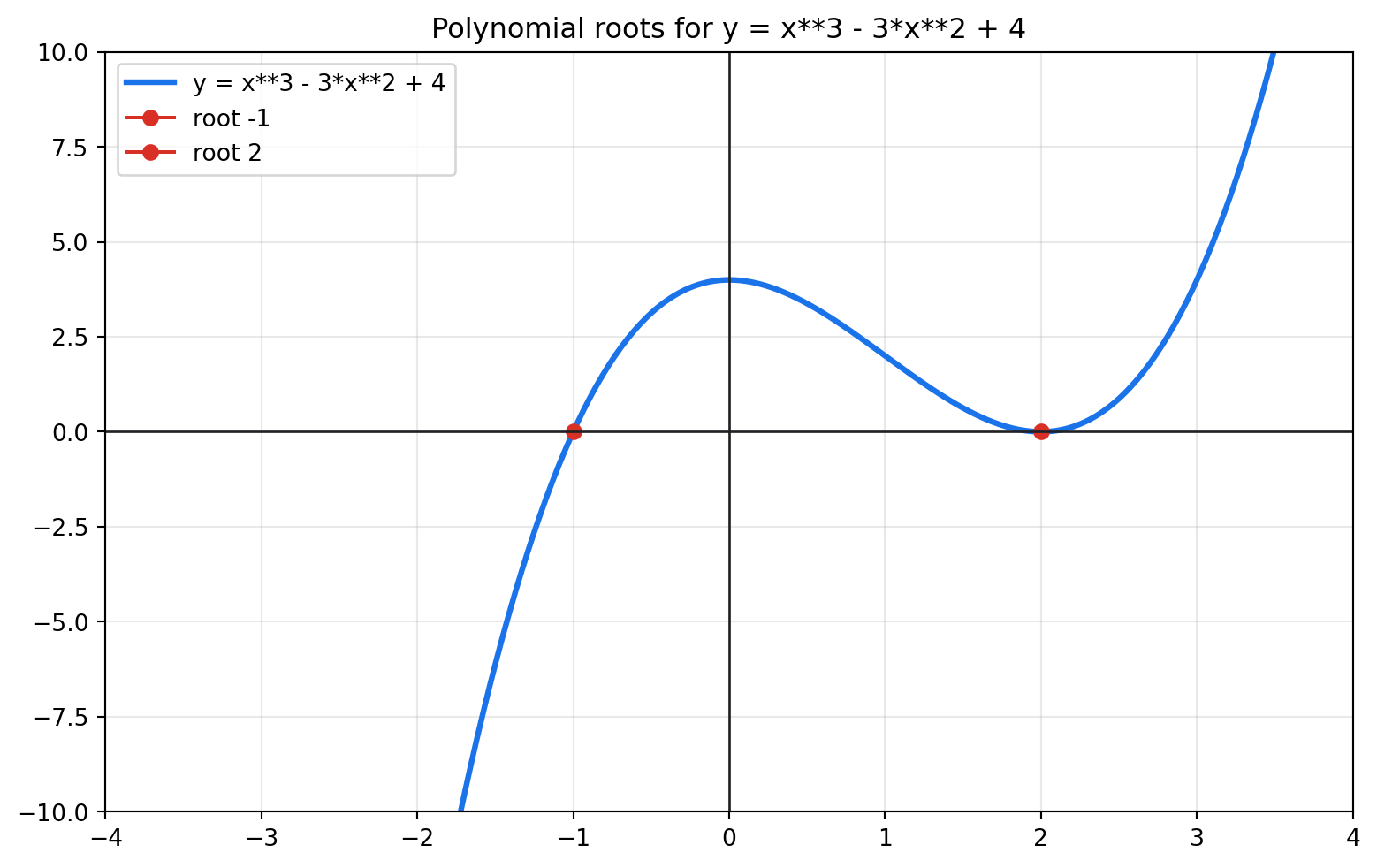
Further reading
- OpenStax, College Algebra 2e, polynomial functions: https://openstax.org/books/college-algebra-2e/pages/index
- OpenStax, Precalculus, polynomial and rational functions: https://openstax.org/books/precalculus/pages/index
- Paul’s Online Math Notes, polynomial functions: https://tutorial.math.lamar.edu/